Sunday, 15 September 2013

The Arvernian Kingdom - was this the beginning of the French state?


As is usual with Gallic history, if the Greeks or Romans didn't write about it, we pretty much don't know what happened in Gaul other than what 2000-year old ruins can tell us. Add to this a few preconceptions the Romans in particular have provided modern scholars and we can have a lot of trouble nailing down exactly what was happening in central or 'Celtic' Gaul before 126 BC. At some point during the 4th or early 3rd centuries BC the Arverni began doing their own empire building - again roughly corresponding with Rome's rise in Italy. The neighbouring tribal states of the Cadurci, Eleuteti, Gabali and Vellavii - mostly to the southwest or across the Central Massif, were folded into a growing Arvernian Kingdom. In doing so, this probably made the Arvernian Kingdom the third most powerful 'nation' state west of Greece - behind Rome and Carthage. And the growth didn't stop there. By the end of the 3rd-century BC - around the time Hannibal was campaigning in Italy, the Arvernian Kingdom had expanded eastwards to swallow up the vital trading routes along the Rhone and Saone valleys, placing the powerful tribal states of the Allobroges and Aedui under Arvernian rule. At this point the Arvernian Kingdom stretched across all of southern France to the Alps, and almost as far north as Orleans, Paris and the borders of Belgic Gaul. At this point, the Arverni probably controlled more lands and people than Rome or Carthage. While understated, this point in history defines the long standing southern, eastern and western boundaries of  the proto-French state for the first time.
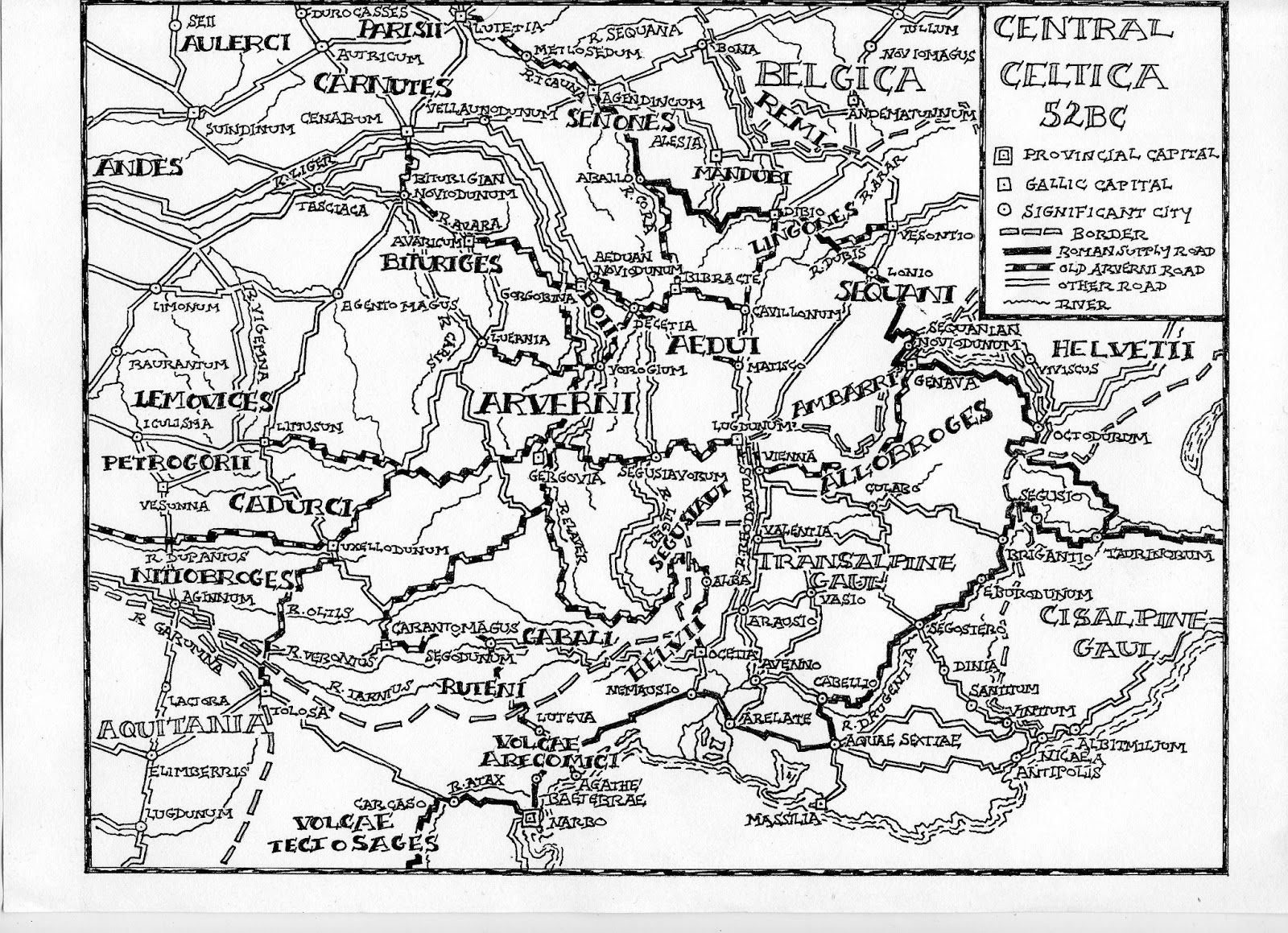


So how did they do it? Brute strength - like Rome - would be the easy answer, however luck and circumstance can't be ignored. As I've already mentioned, they controlled most of the land routes between Carthaginian Spain and Gaul for at least three centuries. By the 3rd-century BC, they controlled all of the land routes, not to mention the Rhone and any access to the Alps. Hannibal's journey across Gaul was almost entirely through the Arvernian Kingdom, and much of his Gallic troops and resources were provided by tribes controlled by the Arverni. What we can take from this is a strong alliance existed between the Arverni and the Carthage during the Second Punic war, something that has been overlooked in the past with most historians considering Hannibal's passage of Gaul as an event independent of Gallic approval. And on the back of this alliance, with Rome busy fighting off Hannibal and warriors from parts of the Arvernian Kingdom, the Arverni reach the height of their powers and wealth...coincidence? With Carthage behind them, the Arverni were too powerful to be stopped by Rome. But what would happen when Carthage vanished?

For more Arvernian history check out 'The Hitherto Unknown' - live on Amazon now

Thursday, 5 September 2013

The Arverni - the also rans


Parallels are frequently made between the rise of Carthage and Rome - they were founded at roughly the same time and used different economic models to become the pre-eminent Mediterranean superpowers of the 3rd and 2nd-centuries BC. Ultimately we got to see the Roman model of 'world domination' by military might and financial trade trumped 'world domination' by controlling mercantile trade. However, often forgotten in this scenario is another western tribal state with again many parallels and connections to Rome and Carthage. This is the regional - rather than city - state of the Arverni.


Just as the Romans were arriving in Italy, the Arvernians arrived in central France around 700BC. The Romans and Arvernians both originated from parts of modern day Austria and these two Celtic cultures both replaced existing populations where they settled. In the area around Clermont-Ferrand the Arvernians displaced a much older European culture that was forced westwards to the Atlantic coast to become the Aquitani - who have since become the linguistically unique Basques. The Arvernians then established the tribal hilltop capital -  Gergovia - but unlike the Romans who settled for a single city, the Arvernians took control of a vast area of central Gaul west of the Loire River, south to and over the Central Massif and west into the Dordogne and Lot Valleys. In doing so they held almost all of the richest river valley's across western Gaul giving them prime agricultural ground and an ability to trade directly into the Atlantic.

The fact their trade routes were westward facing rather than eastward gives some big hints that as the Mediterranean power bases moved from Greece and Egypt to North Africa, Italy and Spain, early Arverni wealth was almost certainly derived from the British metal trade moving cross-country into Gaul or southeast to Etruria. However, as Carthage became more heavily involved in the Atlantic sea trade during the 5th and 4th-centuries it would seem the Arverni were in a perfect position to tax and profit from those growing Atlantic trade routes crossing Gaul, and new overland corridors to Carthaginian Spain. In other words, while later Arverni history was intrinsically shaped by Rome, the formative centuries leading to the creation of a Pan-Gallic Arvernian kingdom was most likely driven by Carthage.


For more Arvernian history - check out 'The Hitherto Unknown' - live on Amazon now

Tuesday, 27 August 2013

So why didn't Rome have an industrial revolution?


One of those big 'ifs' of the Roman-era is how close did they come to having an 'Industrial Revolution' similar to that experienced in the 18th and 19th-centuries? After all, following the same time line that we have - if the atmospheric steam engine had been invented in 12AD, then the Romans may have ended up with nuclear energy in 245AD. Does that sound incredible? It shouldn't. We were no more technically advanced at the beginning of the 18th-century than 1st-century AD Romans, but we still managed to harness (or split) the atom by 1945. Thank goodness they didn't have the stationary steam engine, eh? Can you imagine a world beset with the best and worst of nuclear technology for the last 1800-years?

Well, trouble is, despite the first successful atmospheric steam engine being credited to Thomas Newcomen in 1712, the first 'usefully employed' steam engine was fired up around 40AD. This was when Hero of Alexandria demonstrated the closed-system steam-syphon engine to automatically open and close doors. Perhaps happily (or unhappily) for us, Hero was more interested in theatrics and urban automation rather than finding industrial uses for his steam engines. But the facts are pressurised steam boilers were common place in every Roman bathhouse and Hero proves an understanding for steam cylinders and water pumps...the trouble is, unlike Newcomen - who saw the machine as a solution to pumping water from flooded mines - Hero clearly never visited Spain where he would have seen miners beset with the same troubles as those in 18th-century England.

Perhaps if he had, our earliest steam engineer might have seen how an open-system steam engine could replace the dozens of slaves driving the pumps and water-wheels. Makes you think what might have happened, eh? For more on Roman History - check out 'A Body of Doubt' - live on Amazon now 

Monday, 26 August 2013

How does the Roman economy compare to our recent past?


We know as far empires go Rome was a biggie (sorry, couldn't help making a Life of Brian quote)...but not all empires are made equal - the Zulus and Persians had big empires too - but their economies fell far behind the Romans. In the end, how much money you have is what counts in making and sustaining a great empire, and if you have any doubts about the Roman-era here's a snapshot of Imperial annual metal production during the 1st-century AD.

Pig iron; 82,500-tons. At the same time the Han Empire in China was producing about 5,000-tons and in 1759, Britain was producing 35,000-tons

Copper; 15,000-tons. In 1860 the United States was producing 8,000-tons

Lead; 80,000-tons. Lead production in the United States in 1845 was 33,750-tons

Silver; 200-tons. Total Roman-era silver stock was estimated at around 10,000-tons, ten times more than the combined holdings of medieval Europe. In 1995 the United States produced 1640-tons.

Gold; 9-tons. This is from just the two Spanish provinces. World-wide production between 1800 and 1850 averaged just 24-tons per annum.

The up-shot? The British Empire's economy probably didn't overtake that of 1st-century Rome until the late 18th-century, and the United States during the 1860s. Yep, the Roman Empire was a biggie. For more on the Roman economy, you can read 'A Body of Doubt' - available from Amazon, just follow the links

Thursday, 15 August 2013

Pepper, nothing to sneeze at


If there's one thing that has stayed the same since the Mesopotamians invented the shekel five thousand years ago, its economics. At its most basic level economics relies on human nature - which has remained a constant throughout the history of civilisation. Consumers will always want to pay less...and the less they pay, the more they will consume.

Case in point...Romans and black pepper.

Originally from South East Asia, black pepper first arrived in Greece during the 4th-century BC - but having travelled the land route from India, it was incredibly expensive, and only the super rich were able to acquire a taste for the spice. By the 2nd-century BC black pepper was being cultivated throughout southern India, reducing some of the costs, but it remained more expensive than the 'long pepper' (piper longum - a spice virtually unheard of these days and not to be confused with chili) grown in northern India...simply because the 'long pepper' plantations were closer by road to Europe than those in the south.

But all that changed when Augustus annexed Egypt in 30BC. For the first time Rome controlled the shipping routes to India, and for the first time freight costs from southern India fell below those to the north. Black pepper's price dropped overnight and demand sky-rocketed. More black pepper was planted in India, and farmers began growing the spice in Java and Madagascar. The 78AD prices Pliny gives us says it all. The previously cheaper 'long pepper' - still being road hauled from modern Pakistan through Mesopotamia to the Nabataean trading cities like Petra - cost 15 denarii per pound ($1500), however the black pepper coming from southern India by ship was selling for 4 denarii per pound ($400). By this time black pepper was appearing in most Roman cooking...and at $25 an ounce (one sesterce) almost anyone could afford it. A classic case of supply and demand. Black pepper got cheaper, and 'long pepper' disappeared from recipes. For more on Roman transport - you can read 'The Hitherto Unknown' - available from Amazon, just follow the links 

Tuesday, 13 August 2013

Roman Factories


We tend to imagine ancient households - if we imagine them at all - with the lady of the house spending her day by the millstone making flour for the day's bread. It was backbreaking work - it takes a lot of grain to make a loaf of bread. Roman soldiers on the march carried portable millstones as part of their tent kit - shared between ten men - bread was just too important to go without, even while you were marching twenty-five miles a day. But a snippet from Pliny gives the urbane 'daily grind' a totally new take. In 78AD he writes "...most of Italy uses a bare pestle and a millstone driven by a waterwheel." Not a whole lot to go on, but basically what he's saying is that most grain milled in Italy was done so in flour mills and factories. Just like today, flour milling was an industrial process - and most housewives weren't crouched around their grindstone making gritty flour - instead they were walking down to the shop to buy white or wholemeal, or even better, going to the bakery. For more on everyday life in Ancient Rome, you can read "Mischance and Happenstance" - available from Amazon, just follow the links

Sunday, 11 August 2013

Slaving in the navy


I guess most of us have seen Charlton Heston rowing his heart out as the galley slave Ben Hur. I'm sure some of us have even read General Lew Wallace's 1880 novel of the same name...again featuring our Jewish hero slaving away in the depths of a Roman warship chained to the floor and facing certain death if the ship should sink. It's a graphic picture of hardship and very important to Wallace's narrative. The trouble is...the Roman's didn't use galley slaves. Think about it - if you're going to take an expensive warship off to war (a trireme was worth $4.8-million in today's terms), do you really want to trust its primary motive power to bunch of slaves who may well prefer the other side to win?

The Romans, like the Greeks and Carthaginians relied on trained professionals to row their warships. They were paid well and they trained hard. The Greek Trireme used 170 rowers while the Romans needed 280 for their Quinremes. But that's not to say they were at the drum all day long. These ships were under sail most of the time, or cruised with only some of the rowers working. The full crew only came into play during what we would call 'battle stations'. At this point the crew's full compliment would be at the oars in a 1 + 1 + 1 fashion on a three decked trireme or a 2 + 2 + 1 on a three deck Quinreme. The oarsmen were need for the explosive acceleration ancient warships relied on to approach the enemy, avoid the enemy or ram the enemy. The modern day trireme replica 'Olympia' has achieved nine knots with a largely untrained crew - so imagine what ten-year veterans would be capable of. For more history on the Roman navy - check out 'Mischance and Happenstance' - available on Amazon, just follow the links