Sunday, 22 September 2013

Did the Arverni have a distinct appearance?


We've covered the stylistic appearances of the Celtic Gauls before, so this answer is going to be more about the physical face the Arvernian people presented to the ancient world - and to attempt to describe the average inhabitant of central Gaul. For starters, we know the Romans and Arverni shared the same common ancestors, so many of the faces we see in Republican-era Roman busts will reflect in some way what an Arvernian looked like. Of course, by the 3rd-century BC the 'Celtic' Romans were mixing with Etrurians (who originated from Turkey) and pre-Celtic Italian populations, so tendencies towards darker hair and skin would have been changing the 'look' of the Republican Roman from that of Romulus and Remus. However this was most likely not happening in Celtic Gaul, where the population probably remained largely homogeneous - with some exceptions on the Mediterranean peripheries where Punic, Greek, Etrurian and later Roman colonies existed or in the borderlands of the Belgic Gauls whose general appearance may actually survive in the modern Flemish and Dutch populations.

So having said all that, here's my best guess of an Arvernian. With a higher protein diet than Romans, Arvernian men and women were generally taller - many would have stood at least 6'0", with average heights of men and women being somewhere around or above 5'6" whereas the Roman average was closer to 5'4" and Roman men rarely reached 6'0". The Arverni were not heavily built like the Belgics and Germans, instead they tended towards a lanky Scandinavian-like body shape - perhaps with a more rounded face, high cheekbones and eyes closer set as a result.

Their skin has been described as milky white so their complexion would be generally described as fair, although blonde hair and blue eyes may not have been as common as you might think. Even today the population of central France tends towards brown to black hair, so I think it's a reasonable assumption the Arverni did too, with brown eyes much more common, with red hair and freckled skin appearing occasionally (the latter appears far more common in post-Viking cultures than the pre-Viking populations of western Europe). What may have made an Arvernian distinctive (or at least some of them) was their nose. The coins of Vercingetorix exhibit a long straight nose diving downwards from the forehead, a family trait perhaps, but a shape that can still be seen in modern post-Celtic cultures in Britain and Ireland.

Okay, so is it possible to still see the 'Arvernian' look in popular culture? Off the top of my head I can think of two actors who offer a modern day resemblance to the people of Celtic Gaul. Liam Neeson and Tamsin Greig both share many of the traits that would have been common to the Arverni - in fact Tamsin was born in a part of England where Arverni refugees from the 'Great Rebellion' most likely settled - this is of course most likely coincidence, but an interesting one nonetheless. Lets hope next time a movie is made about Vercingetorix they both get starring roles.

For more Arvernian history check out 'The Hitherto Unknown' - available from Amazon, just follow the links

Sunday, 15 September 2013

The Arvernian Kingdom - was this the beginning of the French state?


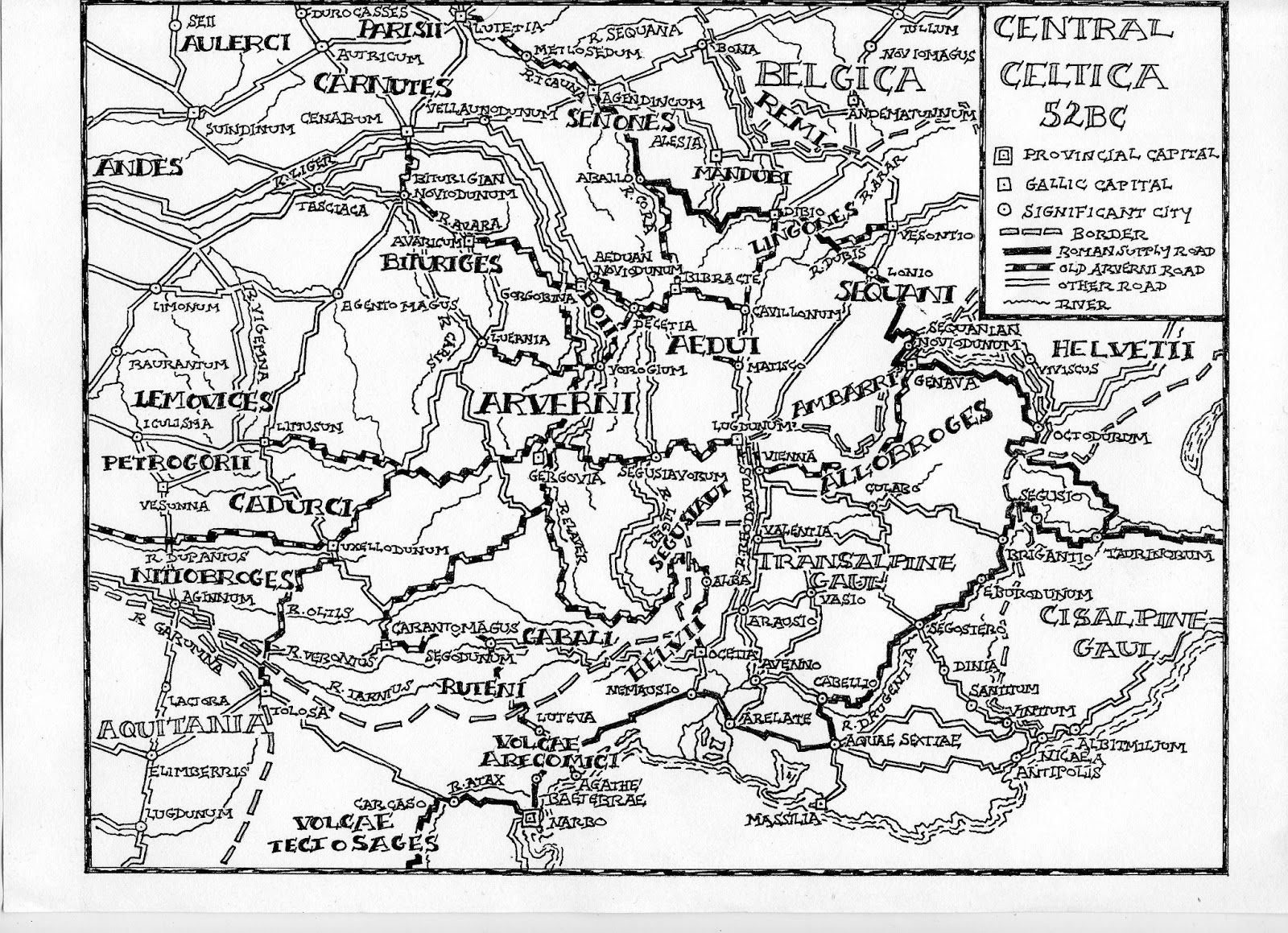
As is usual with Gallic history, if the Greeks or Romans didn't write about it, we pretty much don't know what happened in Gaul other than what 2000-year old ruins can tell us. Add to this a few preconceptions the Romans in particular have provided modern scholars and we can have a lot of trouble nailing down exactly what was happening in central or 'Celtic' Gaul before 126 BC. At some point during the 4th or early 3rd centuries BC the Arverni began doing their own empire building - again roughly corresponding with Rome's rise in Italy. The neighbouring tribal states of the Cadurci, Eleuteti, Gabali and Vellavii - mostly to the southwest or across the Central Massif, were folded into a growing Arvernian Kingdom. In doing so, this probably made the Arvernian Kingdom the third most powerful 'nation' state west of Greece - behind Rome and Carthage. And the growth didn't stop there. By the end of the 3rd-century BC - around the time Hannibal was campaigning in Italy, the Arvernian Kingdom had expanded eastwards to swallow up the vital trading routes along the Rhone and Saone valleys, placing the powerful tribal states of the Allobroges and Aedui under Arvernian rule. At this point the Arvernian Kingdom stretched across all of southern France to the Alps, and almost as far north as Orleans, Paris and the borders of Belgic Gaul. At this point, the Arverni probably controlled more lands and people than Rome or Carthage. While understated, this point in history defines the long standing southern, eastern and western boundaries of  the proto-French state for the first time.


So how did they do it? Brute strength - like Rome - would be the easy answer, however luck and circumstance can't be ignored. As I've already mentioned, they controlled most of the land routes between Carthaginian Spain and Gaul for at least three centuries. By the 3rd-century BC, they controlled all of the land routes, not to mention the Rhone and any access to the Alps. Hannibal's journey across Gaul was almost entirely through the Arvernian Kingdom, and much of his Gallic troops and resources were provided by tribes controlled by the Arverni. What we can take from this is a strong alliance existed between the Arverni and the Carthage during the Second Punic war, something that has been overlooked in the past with most historians considering Hannibal's passage of Gaul as an event independent of Gallic approval. And on the back of this alliance, with Rome busy fighting off Hannibal and warriors from parts of the Arvernian Kingdom, the Arverni reach the height of their powers and wealth...coincidence? With Carthage behind them, the Arverni were too powerful to be stopped by Rome. But what would happen when Carthage vanished?

For more Arvernian history check out 'The Hitherto Unknown' - live on Amazon now

Thursday, 5 September 2013

The Arverni - the also rans


Parallels are frequently made between the rise of Carthage and Rome - they were founded at roughly the same time and used different economic models to become the pre-eminent Mediterranean superpowers of the 3rd and 2nd-centuries BC. Ultimately we got to see the Roman model of 'world domination' by military might and financial trade trumped 'world domination' by controlling mercantile trade. However, often forgotten in this scenario is another western tribal state with again many parallels and connections to Rome and Carthage. This is the regional - rather than city - state of the Arverni.


Just as the Romans were arriving in Italy, the Arvernians arrived in central France around 700BC. The Romans and Arvernians both originated from parts of modern day Austria and these two Celtic cultures both replaced existing populations where they settled. In the area around Clermont-Ferrand the Arvernians displaced a much older European culture that was forced westwards to the Atlantic coast to become the Aquitani - who have since become the linguistically unique Basques. The Arvernians then established the tribal hilltop capital -  Gergovia - but unlike the Romans who settled for a single city, the Arvernians took control of a vast area of central Gaul west of the Loire River, south to and over the Central Massif and west into the Dordogne and Lot Valleys. In doing so they held almost all of the richest river valley's across western Gaul giving them prime agricultural ground and an ability to trade directly into the Atlantic.

The fact their trade routes were westward facing rather than eastward gives some big hints that as the Mediterranean power bases moved from Greece and Egypt to North Africa, Italy and Spain, early Arverni wealth was almost certainly derived from the British metal trade moving cross-country into Gaul or southeast to Etruria. However, as Carthage became more heavily involved in the Atlantic sea trade during the 5th and 4th-centuries it would seem the Arverni were in a perfect position to tax and profit from those growing Atlantic trade routes crossing Gaul, and new overland corridors to Carthaginian Spain. In other words, while later Arverni history was intrinsically shaped by Rome, the formative centuries leading to the creation of a Pan-Gallic Arvernian kingdom was most likely driven by Carthage.


For more Arvernian history - check out 'The Hitherto Unknown' - live on Amazon now

Tuesday, 27 August 2013

So why didn't Rome have an industrial revolution?


One of those big 'ifs' of the Roman-era is how close did they come to having an 'Industrial Revolution' similar to that experienced in the 18th and 19th-centuries? After all, following the same time line that we have - if the atmospheric steam engine had been invented in 12AD, then the Romans may have ended up with nuclear energy in 245AD. Does that sound incredible? It shouldn't. We were no more technically advanced at the beginning of the 18th-century than 1st-century AD Romans, but we still managed to harness (or split) the atom by 1945. Thank goodness they didn't have the stationary steam engine, eh? Can you imagine a world beset with the best and worst of nuclear technology for the last 1800-years?

Well, trouble is, despite the first successful atmospheric steam engine being credited to Thomas Newcomen in 1712, the first 'usefully employed' steam engine was fired up around 40AD. This was when Hero of Alexandria demonstrated the closed-system steam-syphon engine to automatically open and close doors. Perhaps happily (or unhappily) for us, Hero was more interested in theatrics and urban automation rather than finding industrial uses for his steam engines. But the facts are pressurised steam boilers were common place in every Roman bathhouse and Hero proves an understanding for steam cylinders and water pumps...the trouble is, unlike Newcomen - who saw the machine as a solution to pumping water from flooded mines - Hero clearly never visited Spain where he would have seen miners beset with the same troubles as those in 18th-century England.

Perhaps if he had, our earliest steam engineer might have seen how an open-system steam engine could replace the dozens of slaves driving the pumps and water-wheels. Makes you think what might have happened, eh? For more on Roman History - check out 'A Body of Doubt' - live on Amazon now 

Monday, 26 August 2013

How does the Roman economy compare to our recent past?


We know as far empires go Rome was a biggie (sorry, couldn't help making a Life of Brian quote)...but not all empires are made equal - the Zulus and Persians had big empires too - but their economies fell far behind the Romans. In the end, how much money you have is what counts in making and sustaining a great empire, and if you have any doubts about the Roman-era here's a snapshot of Imperial annual metal production during the 1st-century AD.

Pig iron; 82,500-tons. At the same time the Han Empire in China was producing about 5,000-tons and in 1759, Britain was producing 35,000-tons

Copper; 15,000-tons. In 1860 the United States was producing 8,000-tons

Lead; 80,000-tons. Lead production in the United States in 1845 was 33,750-tons

Silver; 200-tons. Total Roman-era silver stock was estimated at around 10,000-tons, ten times more than the combined holdings of medieval Europe. In 1995 the United States produced 1640-tons.

Gold; 9-tons. This is from just the two Spanish provinces. World-wide production between 1800 and 1850 averaged just 24-tons per annum.

The up-shot? The British Empire's economy probably didn't overtake that of 1st-century Rome until the late 18th-century, and the United States during the 1860s. Yep, the Roman Empire was a biggie. For more on the Roman economy, you can read 'A Body of Doubt' - available from Amazon, just follow the links
Thursday, 15 August 2013

Pepper, nothing to sneeze at


If there's one thing that has stayed the same since the Mesopotamians invented the shekel five thousand years ago, its economics. At its most basic level economics relies on human nature - which has remained a constant throughout the history of civilisation. Consumers will always want to pay less...and the less they pay, the more they will consume.

Case in point...Romans and black pepper.

Originally from South East Asia, black pepper first arrived in Greece during the 4th-century BC - but having travelled the land route from India, it was incredibly expensive, and only the super rich were able to acquire a taste for the spice. By the 2nd-century BC black pepper was being cultivated throughout southern India, reducing some of the costs, but it remained more expensive than the 'long pepper' (piper longum - a spice virtually unheard of these days and not to be confused with chili) grown in northern India...simply because the 'long pepper' plantations were closer by road to Europe than those in the south.

But all that changed when Augustus annexed Egypt in 30BC. For the first time Rome controlled the shipping routes to India, and for the first time freight costs from southern India fell below those to the north. Black pepper's price dropped overnight and demand sky-rocketed. More black pepper was planted in India, and farmers began growing the spice in Java and Madagascar. The 78AD prices Pliny gives us says it all. The previously cheaper 'long pepper' - still being road hauled from modern Pakistan through Mesopotamia to the Nabataean trading cities like Petra - cost 15 denarii per pound ($1500), however the black pepper coming from southern India by ship was selling for 4 denarii per pound ($400). By this time black pepper was appearing in most Roman cooking...and at $25 an ounce (one sesterce) almost anyone could afford it. A classic case of supply and demand. Black pepper got cheaper, and 'long pepper' disappeared from recipes. For more on Roman transport - you can read 'The Hitherto Unknown' - available from Amazon, just follow the links 

Tuesday, 13 August 2013

Roman Factories


We tend to imagine ancient households - if we imagine them at all - with the lady of the house spending her day by the millstone making flour for the day's bread. It was backbreaking work - it takes a lot of grain to make a loaf of bread. Roman soldiers on the march carried portable millstones as part of their tent kit - shared between ten men - bread was just too important to go without, even while you were marching twenty-five miles a day. But a snippet from Pliny gives the urbane 'daily grind' a totally new take. In 78AD he writes "...most of Italy uses a bare pestle and a millstone driven by a waterwheel." Not a whole lot to go on, but basically what he's saying is that most grain milled in Italy was done so in flour mills and factories. Just like today, flour milling was an industrial process - and most housewives weren't crouched around their grindstone making gritty flour - instead they were walking down to the shop to buy white or wholemeal, or even better, going to the bakery. For more on everyday life in Ancient Rome, you can read "Mischance and Happenstance" - available from Amazon, just follow the links

Sunday, 11 August 2013

Slaving in the navy


I guess most of us have seen Charlton Heston rowing his heart out as the galley slave Ben Hur. I'm sure some of us have even read General Lew Wallace's 1880 novel of the same name...again featuring our Jewish hero slaving away in the depths of a Roman warship chained to the floor and facing certain death if the ship should sink. It's a graphic picture of hardship and very important to Wallace's narrative. The trouble is...the Roman's didn't use galley slaves. Think about it - if you're going to take an expensive warship off to war (a trireme was worth $4.8-million in today's terms), do you really want to trust its primary motive power to bunch of slaves who may well prefer the other side to win?

The Romans, like the Greeks and Carthaginians relied on trained professionals to row their warships. They were paid well and they trained hard. The Greek Trireme used 170 rowers while the Romans needed 280 for their Quinremes. But that's not to say they were at the drum all day long. These ships were under sail most of the time, or cruised with only some of the rowers working. The full crew only came into play during what we would call 'battle stations'. At this point the crew's full compliment would be at the oars in a 1 + 1 + 1 fashion on a three decked trireme or a 2 + 2 + 1 on a three deck Quinreme. The oarsmen were need for the explosive acceleration ancient warships relied on to approach the enemy, avoid the enemy or ram the enemy. The modern day trireme replica 'Olympia' has achieved nine knots with a largely untrained crew - so imagine what ten-year veterans would be capable of. For more history on the Roman navy - check out 'Mischance and Happenstance' - available on Amazon, just follow the links 

Wednesday, 31 July 2013

Ancient coins found in Northern Australia


Now some of you probably feel an Australian connection to the ancient trade routes is pretty unlikely, and, yes, if the Southern Continent had any participation in Classical-era shipping it was more about wrecks and castaways than Phoenician mines or lost Egyptian Pyramids. So did these ancient ship wrecks or occasional visits happen? The answer now appears almost certainly a resounding YES. In 1944 five 1000-year old copper coins were found on a Wessel Islands beach off the Northwest coast of Australia. An expedition is currently being undertaken by a Professor of Anthropology at the Indiana University, Ian McIntosh to conduct the first intensive search of the islands for more evidence of a wreck. The coins originated from the the Sultanate of Kilwa in modern day Tanzania - and a key player in the Trans-Indian ocean trade at the time. And while these coins confirm traders passing the Australian coast 1000-years ago, the point is, this unlucky ship or sailor was travelling along the same trade routes established by the ancient Egyptians, Tamils and Chinese perhaps 2000-years beforehand. So there's a chance Professor McIntosh might find some even older evidence during his search. Time, as usual, will tell.  For more on ancient ocean trade you can read 'Vagabond' - available from Amazon, just follow the links


Tuesday, 30 July 2013

Did Australia play a part in the Classical World...


I guess you're wondering where this post is going to go? How could Australia have played any part in Roman history - it wasn't discovered until 1770, right? Well...not really. The concept of a Terra Australis (the Southern Land) dates back to the mid-3rd-century BC and Aristotle. Fisherman from the Indonesian archipelago have been travelling to the northern coasts of the continent for at least a thousand years. During the 15th and 16th-centuries Portuguese and Dutch traders likewise explored and named much of northern Australia. And we shouldn't forget that the sea-borne ancestors of Australia's First peoples discovered the southern continent at least 60,000-years ago.

Yeah, yeah, I know, so what about the Romans? Well, the simple fact is those Portuguese and Dutch traders were following the same trade routes established by the Roman-era Tamil and Sri Lankan traders between India and China - in fact Australia has been on the southern edge of these trade routes for at least 2300-years, and perhaps much longer. So why would those Tamils and Sri Lankans come to Australia? The reasons hadn't changed when the Portuguese, Dutch and British came along - either by accident, or for money. By accident was pretty common - seafarers daring the tropical monsoon season could have ended up anywhere along the vast north Australian coast when the storms blew in. And then there's the money. Economic imperatives haven't changed since paleolithic Siberians began trading beads with Europe thirty thousand years ago. Just as the post-Renaissance traders came to northern Australia looking for money to be made, Roman-era traders could well have done the same.


Australia in 1583 - that's Cape York Penninsular on the right,
the Northern Territory and the Kimberlys are on the left.
The ancient Roman-era Spice Islands are to the north.

Okay, so why isn't there any evidence? Well, there's not a lot of evidence of the Portuguese and Dutch explorers from five-hundred years ago either. In fact most of their reports, maps and discoveries were jealously guarded by their governments and have already been lost to history. And the few expedition camps that might have been established were probably impossible to find a year or two later - let alone now. The simple fact is that Northern Australia was utterly uninviting to the 15th-century European explorers. There was little cultivatable land and little permanent freshwater. The First Australian's they met had little or nothing to trade. There was no mining - so there was no copper, gold or iron to buy. In other words there was no economic imperative to stay and establish trading communities.

The situation was identical when Roman-era traders were passing too - and with no surviving written evidence from that period, the only way a Roman-era contact might be proven is if some day someone finds some broken shards of pottery or a couple of coins on a beach somewhere along the seven thousand kilometres of the North Australian coastline - and as researchers have just begun looking for this evidence there's an increasing possibility Australia's Classical Connection could soon be proved. And even in the absence of such evidence that shouldn't necessarily mean someone employed by Roman traders didn't wash up on a North Australian beach. What we need to understand, is that if the Portuguese or the Dutch tried to trade in Northern Australia, then they probably weren't the first. The colour of money - and how to make some for yourself - hasn't changed since the first coin was minted. A lack of physical evidence for something happening doesn't mean it couldn't have happened, so long as you can find an economic reason for someone trying. I think that economic reason did exist 2000-years ago, so I guess it's time to pull out the metal detector and put on the Aerogard.

Tomorrow I'm going to let you in on a story that might actually back up these claims...For more on Roman-era ocean voyages you can read "Vagabond" - available from Amazon, just follow the links   

Tuesday, 23 July 2013

Roman technology versus the Ritual Object


It's a pretty standard thing in archaeology, something is dug up in a farmer's field that doesn't quite fit in with the standard crockery of a particular era and suddenly it becomes a 'ritual object'. And, yes, a lot of the odd bits and bobs from early history probably do have some sort of ritual or religious connection...but of course, that's not to say they all do. Think about it, if someone digs up a cassette tape in two thousand years time, it might just as easily be described as a ritual object - I mean, geez, there's already a whole generation who don't know what a cassette tape is. So how many things dug up from the Roman-era - currently classified as a 'ritual object' - could be an example of everyday classical age technology?

The Baghdad batteries and the Dendera light bulb have both been largely dismissed as 'ritual objects' by the mainstream - and yes, perhaps they are, but we're not talking computer chips here, both contain pretty basic technology that could have been developed long before the Napoleonic wars. And then there's a long standing 19th & 20th-century attitude that "everything we've invented is brand new so nothing like it could have existed before." A good example of this was the excavation of Caligula's pleasure yachts in Lake Nemi during the 1930s. Several bronze water taps were recovered from the wrecks that so closely resembled modern day faucets they were dismissed as recently dumped rubbish. The fact is, a solution to an ancient problem is going to end up looking very similar to the solution for a modern problem - this is why ancient ship anchors look the same as modern ones and why the 2000-year old Antikythera clockwork computer looks identical to 19th-century mechanical calculators. In the end, mainstream archaeology needs to be more open minded - if a mystery object exhibits modern day characteristics, then there's a reasonable chance it is an ancient solution to the same modern day problem.


So where does this leave the Dendera light bulb? There's no way every Roman household was crammed with batteries and light bulbs...but that's not to say this technology didn't have some important alternatives to household lighting - and that could at least explain the lack of physical evidence for an ancient light bulb in Roman cities. Think tunnels. During the Roman-era more road and water tunnels were dug than at any time before the 1800s. Mining was booming and shafts were going ever deeper - and ever darker. Logically lighting these shafts was with oil lamps, but air quality would have been appalling - to the point where excavations may have become impossible. And, well, that would have cost money. The Dendera light bulb may have been a solution - and probably an expensive one. But was it? I don't know, maybe we should look more closely at Roman mines or tunnels for glass, copper rings and iron spikes. However, chances are, if these objects have been found, they have probably been described as...ritual objectsFor more on day to day Roman technology, you can read 'Mischance and Happenstance' available from Amazon, just follow the links

Monday, 22 July 2013

The Roman light bulb


Okay, so it looks like the Romans may have had batteries and did a bit shock therapy or gold electroplating to mug the less wary jewellery shoppers, but as we know, there's a lot of different uses for electricity. And there's one thing that pretty much put electricity on the map for 19th-century society and gave every household the reason to invest in copper wires...this of course was Thomas Edison's light bulb. I mean, wow, what an invention, right? Well, here's where history gets a little bumpy. Edison didn't invent the light bulb, his patent for a carbon filament light bulb in 1880, was simply an improved filament for an existing light bulb design. In fact, the first vacuum glass light bulb was tested in 1820 by Warren De La Rue, but unfortunately his platinum filament made the bulb too expensive to produce commercially. Prior to that, the first carbon arc lamp was demonstrated by Humphrey Davy in 1809.

So, as it stands the carbon arc lamp has been around for a long time, and all it needs is a strip of carbon as a filament - Davy used a thin slice of charcoal, Edison used carbonised bamboo - which could burn for 1200-hours. The one thing you will notice is that the light bulb is pretty simple. Glass and various kinds of carbonised wood were available during and well before the Roman age, as was, it appears, batteries of similar power to those Davy used. Did these ingredients all end up with an ancient glowing filament? Well, it appears, just possibly, it did. Within the ancient Dendera Temple complex in Upper Egypt the walls of the 2nd or 1st-century BC Hathor Temple reveal something of a mystery. A long transparent vessel containing what appears to be a snake stretched lengthwise is held at one end by a man. Is it a mythological image? Or is it a very large carbon arc light bulb with wires running from it to a battery? The carving does date to a time just when glass blowing was becoming mainstream, it does date to the same era as the Baghdad batteries, and this was the age of classical invention by the Greek scholars living to the north in Alexandria. Does this make a light bulb? Well, I don't think it can be completely ruled out. For more on day to day Roman Technology, you can read 'Mischance and Happenstance', available from Amazon, just follow the links

Sunday, 21 July 2013

The Roman battery


Electricity, it's a child of the 19th-century, right? The Romans might have been pretty clever but they never mastered putting a D cell in a torch...or did they? There does seem to be at least some evidence of wet-cell batteries being used on the peripheries of the Roman Empire. The famous Baghdad Battery is more closely related to the post-Persian Parthian Empire, but these two ancient super powers shared borders, Greek culture and technology.

Okay, so what was the Baghdad battery? Several five-inch tall clay jars have been found around Mesopotamia (modern day Iraq) containing hollow copper cylinders and iron rods that appear to function as anodes and cathodes when the jar is filled with acid. Voltages of up to 0.5-volts have been recorded from modern copies of these vessels using vinegar, and their performance could certainly be boosted if a stronger acid were to be used - the Romans and Parthians would have been quite capable of manufacturing sulphuric and hydrochloric acids which should be able to boost these wet-cells into the region of 4 or 5 volts.

All right, so they had a battery...what was it used for? There's a couple of theories. During this period the Romans and the Egyptians were using bio-electric fish - such as the Torpedo Fish (the electric ray) - to numb severe pain; including gout, child birth and migraines. One could imagine an electric ray would be hard to find in the Mesopotamian deserts, so a 'clay ray' battery might have been a worthy alternative. Then there's the jewellers. Just as we dress up silver by electroplating it with gold, the ancients probably cottoned on pretty quickly to the same game. Importantly, both pain relief and fiddling the jewellery would have provided sufficient cash equity to experiment with battery technology if nothing else. But is that all? Well, maybe. These 'batteries' don't show up in Roman or Parthian rubbish dumps like an Eveready or Duracel would these days...but, maybe, just maybe, Thomas Edison wasn't the first guy to invent the light bulb...more on that later. For more on everyday Roman Technology you can read 'Mischance and Happenstance' - available from Amazon, just follow the links

Thursday, 18 July 2013

What was ancient to the Romans?


Founded in 1894BC, the place where Hammurabi's Code of Laws were first handed down - the old eye for an eye - where much of the Bible's Old Testament was written by imprisoned Judeans, and where on the 10th of June 323BC, Alexander the Great died. This was Babylon. By the time Pliny writes about this great city it is nearly 2000-years old. He describes a city ringed by two walls with circumferences of 60-miles, standing 200-feet high and 50-feet thick. This sounds like a city never meant to fall. But it was already in a fast decline when Pliny described it in 78AD. A victim of 'modern times' many Babylonians were moving to the much newer Greek city of Seleuceia as the Euphrates and Tigris Rivers pushed the Persian Gulf further and further south. With a population of 600,000 Seleuceia was fast becoming the new hub of eastern Mesopotamia. It went on to be destroyed in the sixth-century AD. Goes to show nothing stays the same. And to think, just as Pliny was writing about Babylon 2000-years after its founding, I'm writing this post 2000-years after Pliny. Makes you wonder who'll be writing about our present world in 2000-years...
For more on Roman history, you can read 'Ad Lib', available from Amazon, just follow the links

Sunday, 7 July 2013

Was the Ninth legion wiped out by the Picts? Part III


Okay, so if the Pictones were most likely incapable of raising a force large enough to wipe out an entire Roman legion, then what's the story with the Ninth? Well, the problem for the Ninth is that after being listed in Trajan's legionary records in 108AD, the next listing of legions that survives to the present time is from 165AD - during the reign of Marcus Aurelius...and in the 165AD list, the Ninth Legion and the Twenty-Second Legion are both missing. So what's the story?

I'm tending to bureaucracy on this one, and thanks to Boudica we've got a good idea of the bureaucratic end of the Ninth. Remember the British uprising in 61AD wiped out the Ninth Legion? That means a new enlistment was undertaken the same year or 62AD. And this means the Ninth Legion was due for retirement and another enlisting in 86-87AD. Add another twenty-five years for the next enlistment and the Ninth Legion during Trajan's reign was due for retirement in 111-112AD, just three or four years after it's last mention in the 'official' records.

Is the year 111-112AD important? Well, we know several legions were retired during this period - including the Fifth, Eleventh and Fourteenth. So it appears that the entire Roman army was on the move during the 2nd-century 'teens'. The Sixth was moved from Spain to Britain to replace the Ninth, presumably upon its retirement, and with Trajan's military conquests at an end, his successor, Hadrian may have taken a more rationalist view of his forces and not raised another 'Ninth'. Is that what happened to the Ninth then, it was retired and never formed again? Well, it could be the case...but one thing is almost for sure, no matter what the movies say about the Ninth's disappearance, the Picts probably had very little to do with it.  For more on Roman legions you can read 'Vagabond' - available from Amazon, just follow the links

Tuesday, 2 July 2013

Was the Ninth Legion wiped out by the Picts - Part II


All right, so if the Ninth Legion did march into the nether regions of the Scottish lowlands or highlands and disappeared, did the Picts actually have the capacity to destroy them? Thanks to the Vindolanda tablets found on the frontiers of pre-walled Britain, we can get a reasonable picture of life on the Pictones Border in the years leading up to the 'disappearance' of the Ninth Legion. The Ninth Cohort of Batavians (modern day Dutch) manned the Vindolanda fort between 95AD and 105AD and operated under the command of the Ninth Legion. The letters moving between Vindolanda and the Ninth Legion don't appear to indicate much in the way of violent border transgressions by the Picts, and the wives of officers moved freely on road trips between York and Vindolanda, so even small groups of raiders couldn't have been a big issue.

Is there a reason for this?

Well, geography has always impacted on the Scottish peoples. Throughout history the highlands have restricted the movement of locals and invaders. And the highlands have also restricted population. Even in modern times England's population is ten times that of Scotland, and it's very unlikely the Pictone population was more than 250,000 at the time of the Roman occupation...and it was possibly much less. The highlands also meant much of this population was disparate and isolated. The point is, it would have been just as difficult for the Picts to have assembled an offensive force against a legion as it was for the Scots when they first faced an English invasion.

The facts as they are, it seems unlikely that the Picts could assemble an army large enough to destroy an entire legion, just as there is little evidence for them ever raising an army to invade the Roman territories where most cities and towns didn't even have walls or fortifications and would have seemed very easy pickings.

So was the Ninth wiped out by the Picts? It's pretty unlikely. But we know it disappeared. And we probably also know where. Stay tuned for the next post. For more on the Roman legions you can read 'Vagabond' - available from Amazon, just follow the links


Monday, 1 July 2013

Was the Ninth Legion wiped out by the Picts?


It's one of those enduring narratives of Romano-British history - and has been made the stuff of legend in novels and movies for at least the last sixty years, with two feature films produced on the topic in 2010 and 2011. I'm sure you've heard the story...a Roman legion marches off into the wilds of Scotland and is never heard of again - and it's always the mysterious Ninth Legion, whose missing Eagle inspires heroic efforts by subsequent Romans to find the truth...

So what is the truth? Did the Ninth Legion actually go missing?

Well, first a bit about the Ninth. We come across the Ninth as one of Julius Caesar's Spanish Legions sent into Gaul in 58BC. It subsequently sees action during Caesar's civil war and later under the command of Octavian. During the early years of the Empire the Ninth returns to home-ground in Spain, but by 9BC is up in the Rhineland as the 'Ninth Hispania' dealing with the aftermath of the Varro disaster in the Tuetoburg forest. With the abandonment of the German province the legion heads to Pannonia (modern-day Hungary) and finally it reaches Britain in 43AD as one of the four legions used in Claudius' invasion.

This is where the Ninth gets itself a bad name. In 61AD, the legion is virtually wiped out during the Boudica Rebellion as it marched to relieve the siege of the Colchester. Ten years later and now mostly likely filled with recruits from Gaul, the Ninth settles down in a permanent fortress at York to garrison the northern borders. In 108AD, the legion is still there...and then it disappears.

What happened? Well, that's going to be my next post. For more on the Roman legions, you can read 'Vagabond' - available from Amazon, just follow the links

Sunday, 23 June 2013

Death and taxes


It shouldn't be any surprise to you that the Romans paid taxes - all those grand infrastructure projects needed cash and the average Roman was the big contributor to all those roads and aqueducts. But what did they pay? Well, for one thing, the Romans didn't have an income tax like we're used to - in fact through much of Roman history, they had a Wealth tax instead. Throughout the Republic and up until 167BC, Roman citizens paid tax based on their wealth and asset value. This tax was usually around one percent, but rose to three percent when Senate spending was forced up.

This all ended for the Roman citizens of Rome in 167BC when they were given a tax exempt status and the tax collection was limited to the provinces. The change gave us the term Tax Farmer or Publicani...these were the bad guys who purchased the rights to collect taxes and keep some of the cut. Provincial tax rates rose to four percent per month for the next 150-years and left a lot of unhappy provincials.

Augustus made tax collection the role of government during the early Imperial-era and shook things up again. The citizens of Rome retained their tax free status, but the 'for profit' Tax Farmers were replaced by regional magistrates and bureaucrats who returned the Wealth tax to one percent and enforced a new fixed Poll Tax - a per capita tax which relied on the census to identify tax payers. The Poll Tax proved pretty unpopular in some regions - the Jewish Revolt has been partially blamed on it. But how much was it? In Judea it was two denarii - or about 7.5% of the average income. Of course even if you weren't earning money you still had to come up with those two denarii, which no doubt brewed a lot of trouble. Still, troubles aside, Augustus' Poll Tax actually outlived the Roman Empire - so I guess it worked. For more on the early Imperial-era you can read 'A Body of Doubt' available from Amazon, just follow the links     

Thursday, 20 June 2013

Lock and Key


You probably take locking your house or car for granted. Not a second thought. If you ever wonder who invented those locks, chances are you think it's one of the big brands emblazoned on your key. But, hey, guess what? The mechanics for those locks was figured out more than two thousand years ago. Thanks to the Romans we have spring-loaded multiple tumbler locks, the classic key design we still use...and the padlock. Even the keyring dates to the Roman-era. And like us, they made their locks out of steel and bronze. So the next time you put your key in the door, take a moment to think someone else was doing exactly the same thing when Julius Caesar was the talk of the town. For more on Roman locks you can read 'A Body of Doubt' available from Amazon, just follow the links


Wednesday, 19 June 2013

Finding the Roman Ice trade


If the Romans developed a commercial ice trade then where is the proof? Well, we may actually have some evidence for 'ice' refrigeration when we do a little lateral thinking. The Mediterranean cultures loved their seafood, and the Romans weren't any different. They began oyster cultivation on a massive scale...and some Roman-era oyster beds are still in use around the coast of Sardinia. So big was the demand for oysters across the Roman world, that Roman-era rubbish dumps are generally identified by the amount of oyster shell present. In fact oysters were the fast food of the Roman world. From Britain to Syria, roadside stalls sold oysters to famished travellers by the bucket.

The thing is, a lot of these places where oysters were sold in quantity are hundreds of miles from where the oysters were cultivated. Now a live oyster will survive about four weeks in transit - the reason oyster consumption became so widespread - but they must be kept cool. Without some way of keeping those oysters cool, a traveller in the Syrian desert would have been very brave to sample the local oyster shop. The same goes for any seafood consumed in Rome's landlocked cities - which includes Rome itself. Does this mean fresh goods were packed in ice? Or even evaporative coolers?

From a modern perspective, and presuming the Romans were just as keen not to die from food poisoning as us, then the answer once again points towards a large commercial trade of ice flowing from the northern Germanic lands, the Alps and other highlands in the Roman world...the kind of ho-hum and hum-drum of life the ancient writers never bothered to mention. But just because no one wrote about the Roman ice trade hardly excludes its explanation of the oyster industry. Food for thought, eh? For more on the Roman Ice Trade, you can read 'A Body of Doubt' - available from Amazon, just follow the links